


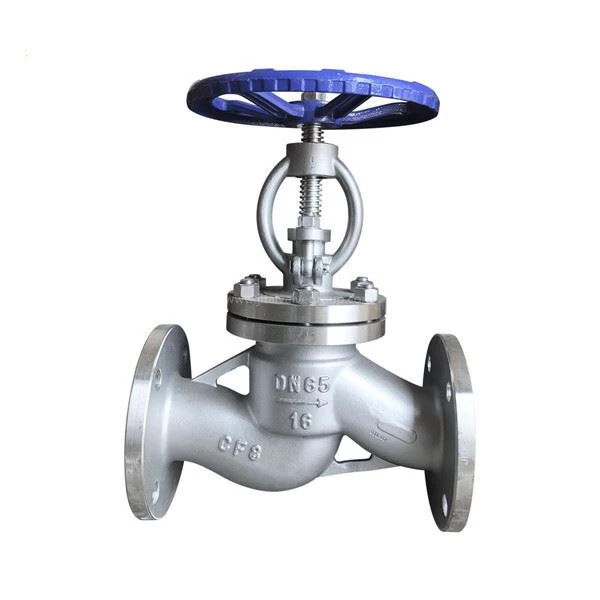
In the entire shipyard piping system, the valve not only has application of shut-up and flow connection , it can also effectively control the medium flow rate, flow direction, pressure and even stability and other critical details. In the current general marine pipeline, the types of valves we usually see are basically: safety valve, booster valve, pressure reducing valve, stop valve, check valve, stop check valve and gate valve. In this article, we will select several common types of marine pipeline valves for analysis and discussion.
1. Check valve
Main function of check valve is to allow the medium in the pipeline to pass in only one direction. If you want to reverse flow, it is impossible. Let's take the lift check valve as an example to talk about several key points of its use. First of all, the lift check valve can only be installed on the horizontal pipe, that is, the horizontal pipe, it is basically not used in the vertical pipeline installation. Secondly, when connecting the lift check valve, the gasket and connection method should be selected correctly, and the appropriate type should be selected for installation with reference to the influence of its working pressure and working temperature. Finally, during the installation process, you must figure out the flow direction of the medium, and ensure that the arrow on the check valve is consistent with the flow direction of the medium. If you encounter unclear signs, you must install it according to the principle of low inlet and high outlet.
2. Globe valve
The globe valve is a particularly versatile valve that we can often see in our daily lives. It is mainly used to connect the medium in the pipeline or cut off the medium in the pipeline. It is generally divided into two types, angle globe valve and straight-through globe valve. Although the globe valve is our most common type, there are still some places we need to pay attention to during its use and installation. For example, we also need to consider its working pressure, working temperature and other conditions to choose the correct type and connection form. The flow direction of the medium and the direction of the arrow also need to be consistent.The handwheels of all shut-off valves are closed in the clockwise direction and open in the counterclockwise direction. This applies to any position.
3. Gate valve
Gate valves are divided into two types: the rising stem and the non-rising stem according to the position of the stem when it is working. The advantage of a gate valve compared with a stop valve is that the flow area of the gate valve is large, the flow resistance is relatively small, and its medium can flow from either side.
4. Valve box
Valve boxes are generally divided into three types: suction valve box, discharge valve box and transfer valve box according to their use. The valve box is for centralized control, combining two or more valve parts into one header. Some valve boxes are integrally cast with cast iron and some are connected by combined valves. Among them, the characteristic of the suction valve box is that the lower part is sucked in separately and then discharged by the upper part, while the characteristic of the discharge valve box is that the lower part is sucked in by the upper part and discharged separately from the upper part.
5. Butterfly valve
The valve disc of the butterfly valve rotates around the valve stem, and it is generally controlled by a butterfly-shaped valve disc and an upright valve stem to control the opening and closing of the valve. A relative advantage of the butterfly valve is that it is easier to achieve automatic control, because the switch of the butterfly valve is generally directly controlled by the rotating valve stem. The automatic control of butterfly valves is generally divided into two types: electric and pneumatic. An indicator is usually installed on the upper end of the butterfly valve, so that the opening and closing status of the valve can be easily understood.


